četvrtak, 5. svibnja 2016.

Bitcoin 'creator' backs out of Satoshi coin move 'proof'

Craig WrightImage copyrightPA
Image captionDr Wright said he did not "have the courage" to prove he is Satoshi Nakamoto
The Australian entrepreneur who has claimed to be the inventor of Bitcoin has reneged on a promise to present new "proof" to support his case.
Craig Wright had pledged to move some of the virtual currency from one of its early address blocks, an act many believe can only be done by the tech's creator.
This would have addressed complaints that earlier evidence he had published online was misleading.
Dr Wright said that he was "sorry".
"I believed that I could put years of anonymity and hiding behind me," he blogged.
"But, as the events of this week unfolded and I prepared to publish the proof of access to the earliest keys, I broke. I do not have the courage. I cannot.
"When the rumours began, my qualifications and character were attacked. When those allegations were proven false, new allegations have already begun. I know now that I am not strong enough for this."
Dr Wright's claims were first reported by the BBC, the Economist and GQ magazine on Monday.

'Extraordinary proof'

Dr Wright had earlier indicated that he would transfer some bitcoins from "block 9" by using a private key thought to be known only to Satoshi Nakamoto, a pseudonym used by the person or team that designed the crypto-currency.
Satoshi is known to have used the address in 2009 to send coins to a computer scientist.
Dr Wright had promised the "extraordinary proof" in light of a growing backlash against one of his blogs.
On Monday, he had posted what seemed to be evidence that he had Satoshi's key by describing a process that led to the creation of a "digital signature".
But soon after, this was attacked by security researchers who linked the signature to an earlier Satoshi Bitcoin transaction that could be found via a search engine.
Dr Wright subsequently wrote that he was the victim of "false allegations" and would prove his case by both moving the coins and by sharing "independently verifiable documents".
You need to install Flash Player to play this content.
Media captionAustralian entrepreneur Craig Wright says he is Mr Bitcoin

Still convinced

Dr Wright's claims had initially been bolstered by the fact that two senior members of the Bitcoin Foundation - an organisation set up to protect and promote the virtual currency - had said they were convinced he was indeed behind the technology.
Dr Wright had shown Gavin Andresen and Jon Matonis other evidence in private.
He apologised to the two men in his latest blog.
"I know that this weakness will cause great damage to those that have supported me, and particularly to Jon Matonis and Gavin Andresen," he wrote.
"I can only hope that their honour and credibility is not irreparably tainted by my actions. They were not deceived, but I know that the world will never believe that now. I can only say I'm sorry. And goodbye."
Mr Matonis has tweeted that there "won't be another Satoshi".
Jon MatonisImage copyrightTwitter
The BBC understands that this tweet signifies that Mr Matonis still believes Dr Wright is indeed Satoshi.
"A lot more people in the Bitcoin community are going to be unconvinced of Dr Wright's claims than will believe he is Satoshi, based upon what's happened to date," commented Dr Garrick Hileman, an economic historian at the Cambridge Centre for Alternative Finance.
"But many of the doubters don't want to be convinced. Satoshi has been mythologised and if you pull back the curtain, you shatter a lot of people's fantasies.
"There are very credible people besides Gavin and Jon who still think he is Satoshi - people who are privy to other information and whose judgement I respect.
"But personally, I have more questions than answers at this point."
Dr Wright's website no longer contains his original blogs, but only his final message.

How Bitcoin works

Bitcoin logoImage copyrightGetty Images
Bitcoin is often referred to as a new kind of currency.
But it may be best to think of its units being virtual tokens rather than physical coins or notes.
However, like all currencies its value is determined by how much people are willing to exchange it for.
To process Bitcoin transactions, a procedure called "mining" must take place, which involves a computer solving a difficult mathematical problem with a 64-digit solution.
For each problem solved, one block of bitcoins is processed. In addition the miner is rewarded with new bitcoins.
This provides an incentive for people to provide computer processing power to solve the problems.
To compensate for the growing power of computer chips, the difficulty of the puzzles is adjusted to ensure a steady stream of several thousand new bitcoins a day. There are about 15 million bitcoins currently in existence.
To receive a bitcoin a user must have a Bitcoin address - a string of 27-34 letters and numbers - which acts as a kind of virtual post-box to and from which the bitcoins are sent.
Since there is no registry of these addresses, people can use them to protect their anonymity when making a transaction.
These addresses are in turn stored in Bitcoin wallets which are used to manage savings.
They operate like privately run bank accounts - with the proviso that if the data is lost, so are the bitcoins owned.

Exploring Chernobyl in virtual reality

You need to install Flash Player to play this content.


25 April 2016 Last updated at 10:21 BST
A game development studio has created an interactive, virtual reality tour of the grounds of the Chernobyl nuclear power plant and the nearby abandoned town of Pripyat.
Viewers of the Chernobyl VR project are able to explore freely while a guide explains the history of a particular area.
The team made multiple trips to Chernobyl and the surrounding exclusion zone to capture thousands of photographs, 3D models and 360 videos in order to recreate an accurate representation of what they saw.
As the area continues to degrade, it is hoped the project will digitally preserve the sites.
Chernobyl was the world's worst nuclear accident - an explosion and fire at the nuclear power station released large quantities of radioactive particles into the atmosphere.
BBC Click's Spencer Kelly finds out more.
(BBC NEWS)

Pilots report more than 1,400 laser incidents in 2015

Laser beamImage copyrightThinkstock
More than 1,400 incidents of lasers being shone at aircraft were reported to the UK's Civil Aviation Authority (CAA) in 2015.
The number was slightly lower than in 2014 - but reports by police helicopter pilots more than doubled.
The British Airline Pilots Association (Balpa) said the increasing power of lasers raised the possibility of a serious accident.
One pilot called for the sale of strong lasers to be controlled.
The CAA said 1,439 laser incidents had been reported in 2015, a slight decrease on the previous year's total of 1,447.
You need to install Flash Player to play this content.
Media captionPilot Janet Alexander: Lasers "inherently dangerous"
But the National Police Air Service told the BBC its helicopter pilots had reported 91 laser incidents in 2015, more than double the previous year's total of 35.
Stephen Landells, flight safety specialist at Balpa, called for lasers to be classed as weapons.
"If you shine even the weakest laser at an aircraft, you can dazzle and distress the pilot at a critical stage of flight," he told BBC Radio 5 live.
"We need to educate people. It's not only illegal, you are actually endangering people's lives when you shine a laser at an aircraft.
"We're looking to try and get the law changed to take into account the fact that these lasers can be used as weapons."
Laser beamImage copyrightNational Police Air Service
Image captionLaser beams can dazzle pilots
Airline pilot Janet Alexander told the BBC: "A concentrated laser beam into the cockpit is analogous to a lightning strike.
"We're not talking about the things you use in lectures... we're talking about the sort of things you might see at an open air music festival or something like that.
"Even if it doesn't hit your retina, it's very dazzling and you do momentarily lose your vision."
A Home Office spokeswoman said: "The UK has strict laws dealing with people who recklessly use lasers against aircraft and endanger the lives of passengers and crew.
"Anybody who does so faces up to five years in prison."
The UK Civil Aviation Authority told BBC Radio 5 live: "We strongly urge anyone who sees a laser being used in the vicinity of an airport to contact the police immediately".

Russia's Valery Gergiev conducts concert in Palmyra ruins


A renowned Russian conductor is performing a concert in the ruins of Palmyra in Syria.
Valery Gergiev, a big supporter of Russian President Vladimir Putin, is conducting an orchestra at Palmyra's Roman Theatre.
Syrian forces, backed by Russian air strikes, took back Palmyra from the so-called Islamic State (IS) in March.
Last July, IS posted footage online showing some of its fighters carrying out killings in the ancient theatre.
Mr Gergiev travelled to Syria with the Symphony Orchestra of St Petersburg's Mariinsky Theatre, where he is artistic director.
You need to install Flash Player to play this content.
Media captionParts of the ancient city of Palmyra were reduced to rubble by the jihadists
He also works as the principal conductor of the London Symphony Orchestra and of the Munich Philharmonic Orchestra.
In 2014, he backed Mr Putin over the annexation of the Crimea, and in 2008, performed in the capital of Georgia's South Ossetia region when Russia and Georgia were fighting over the territory.

Analysis: Steve Rosenberg, BBC News, Moscow

This is more than just about music.
By organising a concert in the ruins of Palmyra, Russia wants the world to see that it is making a positive contribution in Syria: bringing peace and stability to the country, and, in the case of Palmyra, saving a Unesco heritage site.
Moscow will be hoping that images of its classical musicians in Syria will reinforce the message that Russia is a force for good.
Such a musical message will be well received back home: for months now Russian TV has been assuring viewers Russia's military intervention in Syria has benefited the world by taking on international terrorism.
But Western officials remain suspicious of Russia's intentions. Moscow has faced accusations that it has not done enough to rein in Syrian government forces. The Russians deny that and accuse America of not using its influence with the Syrian opposition to halt the fighting.

Image copyright
One of the soloists at the concert was cellist Sergei Roldugin, a friend of Putin's, who was recently named as the owner of offshore companies in the so-called Panama Papers.
Islamic State destroyed a number of monuments during their 10-month occupation of Palmyra and its associated Unesco World Heritage site.
Two 2,000-year-old temples, an arch and funerary towers were left in ruins.
The jihadist group, which has also demolished several pre-Islamic sites in neighbouring Iraq, believes that such structures are idolatrous.
While some treasured monuments were destroyed, much of the ancient city's ruins were unaffected.
Meanwhile, Russia's Victory Day military show in Moscow on 9 May will feature aircraft used in the Syria campaign, Russia's RBK news website reports. They include the Sukhoi Su-35 fighter, a new model combat-tested in Syria.

Much-anticipated monsoon may not solve India's drought crisis


India's killer heatwave is leaving the country reeling from the worst drought in decades and a rural population struggling to survive.


Relief is due with the arrival of the monsoon in mid-June, and because of the impending La Nina weather pattern, the forecast is for above-average rainfall.

However WaterAid India's Head of Policy, Nitya Jacob, says groundwater levels are so depleted that even if a good monsoon comes in June -- and meteorologists predict there will be one that ends the drought -- it won't be enough.

"Even if the monsoon is good, it cannot compensate," Jacob told CNN.

Central Water Commission data shows that India's major reservoirs are 79% empty, and 75% of India's basins are holding less water than the 10-year average.

CNN Meteorologist, Michael Guy, says this is usually the hottest time for the subcontinent, but this year has seen an unprecedented spike in temperatures.


"India is currently in their summer or pre-monsoon season, which lasts from April to late May, or early June," says Guy.

"This year we've seen temperatures range from the lower 40s to as high as 47˚C or 116˚Fahrenheit. For some, this is three to five degrees (Celsius) above normal."

And critically, the past two monsoon seasons have seen below average rainfall.

"This has had a huge impact on groundwater supplies," says Jacob.

Impact on the ground

The government estimates up to 330 million people could currently be affected by the dry climate conditions.

"We are seeing that people don't even have enough water for drinking," says Jacob.

In this photograph taken on April 28, a child points to initials on a water container as she and other villagers queue to collect potable water at a makeshift camp in Mumbai. Some 300 families who have migrated from the drought affected Marathwada region in the hinterlands of the western Indian state of Maharashtra are camped at a municipal ground in the city.

12 photos:

In this photograph taken on April 28, a child points to initials on a water container as she and other villagers queue to collect potable water at a makeshift camp in Mumbai. Some 300 families who have migrated from the drought affected Marathwada region in the hinterlands of the western Indian state of Maharashtra are camped at a municipal ground in the city.

Hide Caption

7 of 12

An Indian woman tries to filter polluted well water with her sari as a child drinks during a water crisis in the Shankargarh area, 45km away from Allahabad, on April 21.

12 photos:

An Indian woman tries to filter polluted well water with her sari as a child drinks during a water crisis in the Shankargarh area, 45km away from Allahabad, on April 21.

Hide Caption

8 of 12

A cow stands in a dried up pond in Bangaye the village of Bangaye on the outskirts of Tikamgarh district in the central Indian state of Madhya Pradesh on April 27.

12 photos:

A cow stands in a dried up pond in Bangaye the village of Bangaye on the outskirts of Tikamgarh district in the central Indian state of Madhya Pradesh on April 27.

Hide Caption

9 of 12

Indian Lambadi tribal villagers fill drinking water from a leaking pipe on a roadside at Chandampet Mandal in Nalgonda east of Hyderabad on April 25, in the southern Indian state of Telangana.

12 photos:

Indian Lambadi tribal villagers fill drinking water from a leaking pipe on a roadside at Chandampet Mandal in Nalgonda east of Hyderabad on April 25, in the southern Indian state of Telangana.Hide Caption
10 of 12
In this photograph taken on April 27, Indian farmer Gassiram Meharwal, 32, stands in his field in the village of Bangaye on the outskirts of Tikamgarh district in the central Indian state of Madhya Pradesh.
12 photos:
In this photograph taken on April 27, Indian farmer Gassiram Meharwal, 32, stands in his field in the village of Bangaye on the outskirts of Tikamgarh district in the central Indian state of Madhya Pradesh.
Hide Caption
11 of 12
An Indian man holds an umbrella as he walks on the dry reservoir bed next to Gunda Dam by Gunda village in Botad district, some 150 km from Ahmedabad in India's western Gujarat state, on April 1.
12 photos:
An Indian man holds an umbrella as he walks on the dry reservoir bed next to Gunda Dam by Gunda village in Botad district, some 150 km from Ahmedabad in India's western Gujarat state, on April 1.
Hide Caption
12 of 12
A gunman stands guard at a water reservoir in Tikamgarh in the central Indian state of Madhya Pradesh on April 27.
12 photos:
A gunman stands guard at a water reservoir in Tikamgarh in the central Indian state of Madhya Pradesh on April 27.
Hide Caption
1 of 12
An Indian villager walks with his cattle in the dried up Mansaita River near Allahabad on May 4, 2016.
12 photos:
An Indian villager walks with his cattle in the dried up Mansaita River near Allahabad on May 4, 2016.
Hide Caption
2 of 12
Gunmen stand alert at a water reservoir in Tikamgarh in the central Indian state of Madhya Pradesh on April 27, 2016. Armed men have been securing the Barighat dam against water thefts.
12 photos:
Gunmen stand alert at a water reservoir in Tikamgarh in the central Indian state of Madhya Pradesh on April 27, 2016. Armed men have been securing the Barighat dam against water thefts.
Hide Caption
3 of 12
An Indian farmer tries to revive his unconscious cattle dying on an unploughed field during a water crisis in Gondiya village, 45km from Allahabad, on April 21.
12 photos:
An Indian farmer tries to revive his unconscious cattle dying on an unploughed field during a water crisis in Gondiya village, 45km from Allahabad, on April 21.
Hide Caption
4 of 12
An Indian farmer poses in his dried up cotton field at Chandampet Mandal in Nalgonda east of Hyderabad on April 25, in the southern Indian state of Telangana.
12 photos:
An Indian farmer poses in his dried up cotton field at Chandampet Mandal in Nalgonda east of Hyderabad on April 25, in the southern Indian state of Telangana.
Hide Caption
5 of 12
In this photograph taken on April 27, cattle graze in a partially dried-up pond in Tikamgarh in the central Indian state of Madhya Pradesh. Armed men have been securing the Barighat dam against water thefts by farmers from neighboring states.
12 photos:
In this photograph taken on April 27, cattle graze in a partially dried-up pond in Tikamgarh in the central Indian state of Madhya Pradesh. Armed men have been securing the Barighat dam against water thefts by farmers from neighboring states.
Hide Caption
6 of 12
In this photograph taken on April 28, a child points to initials on a water container as she and other villagers queue to collect potable water at a makeshift camp in Mumbai. Some 300 families who have migrated from the drought affected Marathwada region in the hinterlands of the western Indian state of Maharashtra are camped at a municipal ground in the city.
12 photos:
In this photograph taken on April 28, a child points to initials on a water container as she and other villagers queue to collect potable water at a makeshift camp in Mumbai. Some 300 families who have migrated from the drought affected Marathwada region in the hinterlands of the western Indian state of Maharashtra are camped at a municipal ground in the city.
Hide Caption
7 of 12
An Indian woman tries to filter polluted well water with her sari as a child drinks during a water crisis in the Shankargarh area, 45km away from Allahabad, on April 21.
12 photos:
An Indian woman tries to filter polluted well water with her sari as a child drinks during a water crisis in the Shankargarh area, 45km away from Allahabad, on April 21.
Hide Caption
8 of 12
A cow stands in a dried up pond in Bangaye the village of Bangaye on the outskirts of Tikamgarh district in the central Indian state of Madhya Pradesh on April 27.
12 photos:
A cow stands in a dried up pond in Bangaye the village of Bangaye on the outskirts of Tikamgarh district in the central Indian state of Madhya Pradesh on April 27.
Hide Caption
9 of 12
Indian Lambadi tribal villagers fill drinking water from a leaking pipe on a roadside at Chandampet Mandal in Nalgonda east of Hyderabad on April 25, in the southern Indian state of Telangana.
12 photos:
Indian Lambadi tribal villagers fill drinking water from a leaking pipe on a roadside at Chandampet Mandal in Nalgonda east of Hyderabad on April 25, in the southern Indian state of Telangana.
Hide Caption
10 of 12
In this photograph taken on April 27, Indian farmer Gassiram Meharwal, 32, stands in his field in the village of Bangaye on the outskirts of Tikamgarh district in the central Indian state of Madhya Pradesh.
12 photos:
In this photograph taken on April 27, Indian farmer Gassiram Meharwal, 32, stands in his field in the village of Bangaye on the outskirts of Tikamgarh district in the central Indian state of Madhya Pradesh.
Hide Caption
11 of 12
An Indian man holds an umbrella as he walks on the dry reservoir bed next to Gunda Dam by Gunda village in Botad district, some 150 km from Ahmedabad in India's western Gujarat state, on April 1.
12 photos:
An Indian man holds an umbrella as he walks on the dry reservoir bed next to Gunda Dam by Gunda village in Botad district, some 150 km from Ahmedabad in India's western Gujarat state, on April 1.
Hide Caption
12 of 12
A gunman stands guard at a water reservoir in Tikamgarh in the central Indian state of Madhya Pradesh on April 27.
12 photos:
A gunman stands guard at a water reservoir in Tikamgarh in the central Indian state of Madhya Pradesh on April 27.
Hide Caption
1 of 12
An Indian villager walks with his cattle in the dried up Mansaita River near Allahabad on May 4, 2016.
12 photos:
An Indian villager walks with his cattle in the dried up Mansaita River near Allahabad on May 4, 2016.
Hide Caption
2 of 12
Gunmen stand alert at a water reservoir in Tikamgarh in the central Indian state of Madhya Pradesh on April 27, 2016. Armed men have been securing the Barighat dam against water thefts.
12 photos:
Gunmen stand alert at a water reservoir in Tikamgarh in the central Indian state of Madhya Pradesh on April 27, 2016. Armed men have been securing the Barighat dam against water thefts.
Hide Caption
3 of 12
An Indian farmer tries to revive his unconscious cattle dying on an unploughed field during a water crisis in Gondiya village, 45km from Allahabad, on April 21.
12 photos:
An Indian farmer tries to revive his unconscious cattle dying on an unploughed field during a water crisis in Gondiya village, 45km from Allahabad, on April 21.
Hide Caption
4 of 12
An Indian farmer poses in his dried up cotton field at Chandampet Mandal in Nalgonda east of Hyderabad on April 25, in the southern Indian state of Telangana.
12 photos:
An Indian farmer poses in his dried up cotton field at Chandampet Mandal in Nalgonda east of Hyderabad on April 25, in the southern Indian state of Telangana.
Hide Caption
5 of 12
In this photograph taken on April 27, cattle graze in a partially dried-up pond in Tikamgarh in the central Indian state of Madhya Pradesh. Armed men have been securing the Barighat dam against water thefts by farmers from neighboring states.
12 photos:
In this photograph taken on April 27, cattle graze in a partially dried-up pond in Tikamgarh in the central Indian state of Madhya Pradesh. Armed men have been securing the Barighat dam against water thefts by farmers from neighboring states.
Hide Caption
6 of 12
GettyImages-526701854India droughtGettyImages-528157572India droughtGettyImages-526701784 (1)India droughtGettyImages-522830218India droughtGettyImages-524092582India droughtGettyImages-526701860India droughtGettyImages-526701772India droughtGettyImages-522830312India droughtGettyImages-526701822India droughtGettyImages-524092900India droughtGettyImages-526701826India droughtGettyImages-518647188India drought
In an open letter to India's Prime Minister Narendra Modi in April, more than 150 of India's activists and academics expressed their concern about the drought's impact on the rural population.
"In areas where rains have failed, farmers who depend mainly on rainwater to irrigate their crops have no, or very low, crop yields," they wrote.
"Those who rely on irrigation are also affected, with groundwater sinking and streams and reservoirs drying up."
The combination of heat with humidity makes India a global hot spot for heat-related illnesses and fatalities -- so far the government estimates more than 370 people have died.
2015's heatwave led to around 2,500 deaths in India, making it among the top five deadliest years in recorded history.
"It was a wake-up call for us," said K. Dhananjaya Reddy, the director of disaster management in Andhra Pradesh, a state that saw more than 1,300 deaths in 2015.


Alberta wildfire: Emergency declared in Fort McMurray


A state of emergency has been declared in the province of Alberta in Canada after a wildfire forced all 88,000 residents of Fort McMurray to flee.

Officials say the fast-moving blaze could destroy much of the city.

The fire, which broke out on Sunday in the heart on the country's oil sands region, has gutted 1,600 buildings, including a new school.

The evacuation was largest-ever in Alberta. Oil companies operating in the area have been forced to cut output.

Several firms have shut down some pipelines. This was done to help evacuate non-essential personnel, reports say, but oil facilities are not in the current path of the fire.

So far there have been no reports of deaths or injuries, but two women gave birth in one evacuation centre, Reuters new agency reported.

In pictures - Fort McMurray's evacuation
What residents witnessed

Resident Neil Scott told the BBC: "It was something you'd see in a movie probably. I was stuck between a concrete barrier and the fire and I though 'You know what? I might not make it out'.

"There's whole neighbourhoods that are gone. A hotel burned down, a gas station exploded. One lady that I met she actually was sheltered behind like an electrical box when it actually exploded and she felt a shockwave."
 

srijeda, 4. svibnja 2016.

Nairobi building collapse: Miracle baby's mother dies in rubble

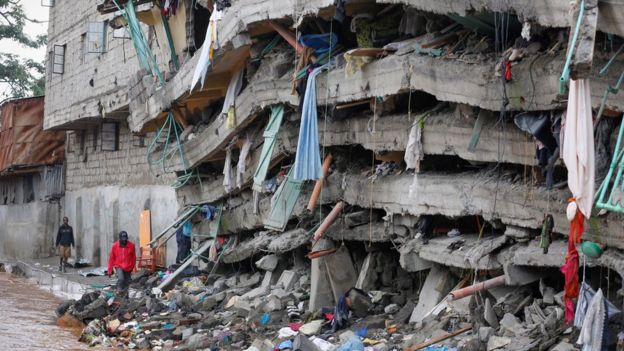
The mother of the six-month-old baby who was rescued from the rubble of a collapsed building in Nairobi is among 26 people who have been confirmed dead.
Rescuers say the body of the woman was found a few metres from where the baby girl was retrieved unhurt on Tuesday.
The presumed owners of the six-storey residence, which came down on Friday night, have been released on bail.
At least 80 people are still missing - rescuers say they are still hopeful of finding people alive.
The co-ordinator of the rescue efforts, Pius Masai, told reporters that the mother's body was among those that had been retrieved from the debris and taken to a local morgue.

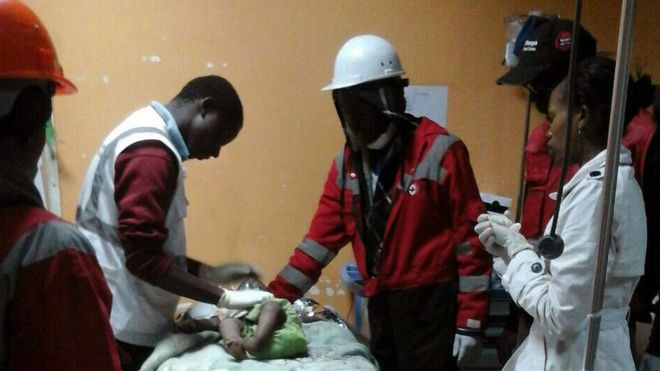
Her baby, named Dealeryn, was found in the rubble at on Tuesday, in a bucket wrapped in a blanket.
Dealeryn appeared dehydrated, but had no visible injuries.
She has been reunited with her father, Ralson Saisi Wasike, who was at work when the accident happened.
Mr Wasike, speaking at a shelter where he has been living since the building collapsed, said his daughter had been strong but he had feared for the worst when he was unable to find her.
He said said his wife kept baby Dealeryn in a washtub when she was doing her household chores.

Strong baby

The fact that the baby was not seriously injured played a key role in her survival, said Dr Ian MacOnachie, an expert in emergency medicine and clinical standards at the UK's Royal College of Paediatrics and Child Health.
Dr MacOnachie told the BBC that, at this age, up to 90% of babies' bodies was made up of water, acting as a "natural storage" in cases of dehydration.
"She must have been fairly dried when she was found. But I'm not completely surprised," he said.
How long can survivors last under rubble?
City authorities say they had earmarked the building for demolition after it was declared unfit for human habitation.
Two brothers, believed to be the building's owners, and three government officials were arrested and released on bail.
Officials say the owners did not have permission to rent out the building's 119 rooms. The owners have not yet commented.